Spring and summer are when yards and gardens retake their rightful places at the center of attention. This month, Pillar To Post takes a look at several steps that homeowners can take to make their outdoor spaces and their home live compatibly.
Keep water away from the house
Be sure that the ground slopes away from the house all the way around the perimeter. This ensures that any moisture from rain and sprinkler systems will be directed away from the foundation.
The base of shrubs and other plantings should be kept at least 2' away from the foundation to avoid potential problems with roots and drainage. In addition, window wells should be kept free of debris and lined with gravel to help water drain out of the well and into the ground.
Do not leave sprinklers on for too long. Excessive water will not do plants and lawns any good, and may cause problems if there are drainage issues in certain areas.
The Right Plant in the Right Place
When a tree is growing very close to a structure, there can be potentially serious problems if the tree grows too tall or too wide for the space. Damage to eaves and roofs can be caused by overgrowth, and there is even a danger of branches or an entire tree falling onto the home. Existing trees should be professionally pruned to lessen the potential for hazard. When planting new trees, homeowners should research potential "candidates" to find how large the tree will eventually grow and make decisions accordingly.
Homeowners should also consider grouping plants that have similar water requirements to avoid overwatering plants that don't need as much. Not only will plants do better, but water bills will be lower over time as well.
Choose plants with maintenance in mind
Some plants end up requiring more maintenance than a homeowner expects. When selecting new planting material, homeowners should seek advice from qualified personnel at a local nursery who will know what plants will do well in their area, their growth habits and maintenance requirements.
Lawns should not be mowed too short or too frequently. Allowing the blades of grass to shade one another helps with water retention and allows grass to grow in more fully. Many newer turf grasses require less mowing than older varieties, and should be considered for new lawn installations. Homeowners can find out more at their local agricultural or extension office.
These are just some of the ways homeowners can increase the enjoyment of their outdoor spaces while ensuring that home and yard are in good shape.
Contact your local Pillar To Post home inspector for references and additional information that may apply to your region.
Pillar To Post welcomes your comments and concerns. You can contact us: Click Here
We all have pessimism ingrained into our persona; and if we let it rule our lives, our accomplishments may be more limited. Not everything in life is great or rosy or always upbeat, but always try and keep your inner belief stoutly positive.
Pessimism, from the Latin word pessimus (worst), denotes a belief that the experienced world is the worst possible. It describes a general belief that things are bad and tend to become worse.
Pessimism - reacting to setbacks from a presumption of personal helplessness:
• Bad events will last a long time • Always my fault • Will undermine everything I do
Optimism is the belief in the goodness and betterment of things. It exemplifies a life view where one looks upon the world as a positive place. Optimists generally believe that people and events are inherently good. They have a so-called “positive” outlook on life, believing that things will work out in the end.
Optimism - reacting to setbacks from a presumption of personal power.
• Bad events are temporary setbacks • Isolated to particular circumstances • Can be overcome by my effort and abilities
Optimism is not magic. But, the event-explanations of optimism can be practiced and learned, even by those who have not consistently used them previously. Optimism has positive benefits:
• Inoculates against depression • Improves health • Combines with talent and desire to enable achievement
How do you maintain the optimistic point of view or change from the pessimist you are. Here are some tips:
1. Build self-confidence. 2. Maintain strong family values. 3. Smile often. 4. Laugh when you can and laugh often. 5. Set short-term, achievable goals as well as long-term goals. 6. Reward yourself for your achievement. 7. Become physically active. 8. Get a pet - a dog or cat or try a turtle or bird. 9. Have the will to try new things.
A favorite quote on optimism comes from Helen Keller, “No pessimist ever discovered the secret of the stars, or sailed to an uncharted land, or opened a new doorway to the human spirit.”
You can become more optimistic and reach for the stars. Give it a try.
Whether you are renovating or looking to make your home more energy efficient.The toughest decision is determining what type of window to install that is within your budget. So it’s important to educate yourself with options.
One of the key factors that influences price when it comes to windows is what they are made of.
VINYL WINDOWS are the least expensive window on the market. They are most popular for budget-conscious retrofits. While some companies are starting to introduce new colors, color options are generally limited to white, almond or brown. Keep this in mind when considering your interior finishes.
ALUMINIUM WINDOWS should not to be confused with aluminum-clad windows, are low-maintenance, strong and won’t rust. But because aluminum is a good thermal conductor, you will lose heat through the frame. So this is not the best option for cold climates.
WOODEN-CLAD WINDOWS are the most versatile when it comes to size and design - they can receive any finish you want on the interior. Naturally, they are generally expensive. A word of caution: When buying wooden clad-windows do your research and choose a reputable manufacturer. A poorly made clad-window will allow moisture to contact the wood, which causes rot.
Do your research, make the decision that’s right for you and your home, and look forward to enjoying the view.
Can’t get away for the weekend? Bring summer indoors with tricks that will turn your home into a breezy, seaside cottage in minutes.
• Summer-ize your decor with toss pillows in shades of turquoise and seafoam green, glass bowls filled with seashells and woven seagrass floor mats (that shake away the extra dirt that gets tracked in during summer).
• Breathe in the salty air with sea-scented candles, sachets and room sprays - It will transport you to the shore.
• Watch the surf crash by hanging up inexpensive prints of beach scenes. Or, make enlarged copies of beach scenes from a travel book and place them in frames.
• Lighten up with whisper-light sheers that gently billow in the breeze. If privacy is not a concern, leave windows bare and let the sun stream in.
TIP! Bring an outdoor table, sofa or chair inside for a fresh, cottage-y feel.
Eggs, a serious staple for any kitchen come in great packages that can be put to other uses once the cooking is done. Here are a few of them:
START SEEDLINGS. Save up the cartons for the spring and get a headstart on planting a vegetable patch. Place potting soil in sections of a cardboard egg carton until three-quarters full, then add seeds. Put in a sunny spot and water the soil until damp. When seeds sprout, cut out each cup and plant outside - the carton will break down in the ground over time.
FREE PACKING MATERIAL. Foam egg cartons are perfect for protecting fragile objects for shipping or storage. Just pull the carton apart and use as an eco-friendly alternative to packing peanuts.
SORT GOLF BALLS. Keep your golf balls contained and out of sight. Simply nestle each ball in its own compartment and then shut the lid to keep them corralled.
MAKE ICE. Don’t run out of ice at your next party. Wash foam egg cartons, then fill the bottom halves with water and stack them in your freezer for an extra stash of ice.
A staple of the North American backyard, pressure treated wood chemically inhibits, fungus and rot. In 2004 CCA (chromated copper arsenate) was discontinued for use in pressure treated wood because it was toxic to the environment and people.
HEALTH RISK Government bodies agree that there is no significant health risk from existing CCA pressure treated wood. They believe that there is not a reason to remove or replace CCA treated structures including decks and playground equipment.
PRUDENT AVOIDANCE This means minimizing exposure which would come from getting arsenic into the mouth, not from only touching CCA treated wood. Children are most at risk since they often put their hands into their mouths. Parents should manage the risk by making sure children always wash hands thoroughly after contact with CCA pressure treated wood. This is especially important with respect to food. Wash hands before eating, make sure no food comes in contact with pressure treated wood, use a table cloth on tables made with CCA treated wood.
NEW PRESSURE TREATED WOOD New pressure treated wood does not contain arsenic or chromium. The two main preservatives are alkaline copper quat (ACQ) and copper azole (CA). These new preservatives have very low toxicity. To make the preservatives effective, the amount of copper used is much higher, four or five times as much. To the consumer, this means higher prices.
STAINS AND COATINGS The U.S. Environmental Protection Agency (EPA) in conjunction with Consumer Product Safety Commission (CPSC) tested the effect of coating existing CCA treated wood to reducing exposure to arsenic. The results were that application of a penetrating sealant can reduce the exposure to one tenth but the protection is short lived. The penetrating sealant should be re-applied every year or two. Oil based, semi transparent stains that soak into the wood are the most effective. Surface coatings such as paint or varnish were not considered to be as effective.
CORROSIVE New pressure treated wood is 5X more corrosive to steel than CCA. Stainless steel fasteners and copper flashing must be used. Galvanized steel fasteners can be used but must be of a higher grade, designed for the application. If the wrong fasteners are used they will corrode very quickly and could lead to failure of the structure.
Feel guilty about surfing the Web, watching TV or playing games? Scientists say that these everyday habits are strengthening your brain power. Here are other brain boosting activities:
Chewing gum fires up focus. Pop a piece of gum before a big test or work presentation. It increases blood flow to the brain, improving brain cell communication
Playing Angry Birds helps you multitask. People who play this and other fun games 15 minutes a day are building new neural brain pathways to increase memory and focus.
Texting improves mental sharpness. Your Hand-eye coordination improves by 25%. Since most of us respond right-away to texts, just by texting our brain is trained to think faster in all situations.
Here are some smart ways to keep your electronics in good repair by keeping them clean and ready for efficient use.
Dust your speakers. If your stereo sound isn’t as crisp as you would like, dust is likely the problem.Remove dust by rolling a lint brush over the front of the speakers.
Fix your DVD player. Dust is the biggest culprit that slows down gadgets. Check the back of equipment for dust buildup in the vents. Cover your vacuum’s nozzle attachment with pantyhose and safely suck dust away.
Disinfect your gaming controllers. Germs build up fast on handheld controllers. Use a disinfecting wipe to surface clean and a cotton swab dipped in rubbing alcohol to remove dirt from the crevices around buttons.
Organize wires. Use the plastic tags from bread bags to mark which wires belong to what electronic. Write “TV” or “DVD” on the clip and attach to the cord.
Since the new preservatives are so expensive, wood is pressure treated only to the extent required for the particular application. For example, deck boards do not need as much preservative as wood that will be in contact with the ground. The three levels of treatment commonly used for pressure treated wood are:
• Decking • Above ground structural elements • Ground contact.
The treatment level is dictated by the dimensions of the lumber. 4X4s and 6X6 are treated for ground contact. 2X lumber is treated for above ground use, smaller than 2X such as 5/4 deck boards is treated at decking levels.
Pillar To Post
welcomes your comments and concerns. You can contact us: Click Here
People procrastinate for a swarm of reasons. Some say it’s simply habit, a
product of how we were brought up, while others think it’s a clear sign of
mental health issues.
Here is a short, fun quiz to see what kind of procrastinator you might be.
When confronted with a large, complex task you: A. Get on it
immediately - too much on your plate makes you anxious. B. Start thinking
about ways to tackle the project by making lists. C. Put it out of your head
completely - due date is a month away.
Your in-laws are coming to dinner. You want to impress them so
you: A. Paint the living room two weeks before the big
day. B. The day before, you clean house, buy fresh flowers and a prime
roast. C. Order in.
At work, colleagues describe your work style as: A. Diligent
but uptight. B. Conscientious and fair. C. Reasonable but a little flaky
and unreliable.
Here’s the interpretation of your answers: If you pick A’s:
You need to procrastinate more or at least relax a bit. If you pick B’s:
You’re well balanced in the procrastination department. If you pick C’s: It’s
time to curb your procrastinating because it’s annoying others.
Here are some helpful suggestions to stop you from your delay tactics.
• Time to jump in - literally. Your mantra should be stop
thinking and start doing. By over thinking and attempting to dream up the
perfect plan you put off the inevitable. Get on with it.
• Do something, anything. If you tend to magnify and blow
things out of proportion, you end up imagining that it’s much worse than it is.
Take the big first step.
• Make deadlines. To help yourself set a manageable pace
other than breakneck, set deadlines or mini deadlines for the completion of
something.
• Large complex tasks. Need to be broken down into smaller
more manageable segments. Attempt each separately. Break four hours of dreaded
paperwork into one-hour slots. Start with the easiest. Take a break after each
block of time and perhaps even treat yourself to a latte.
• Be accountable. Use the friends and family approach by
making yourself accountable to them for completing a project. Look to a trusted
friend for encouragement and support.
• Turn down the volume. Because we are so hyper-connected
these days this can be hard to do, but it’s a must if you’re a diehard
procrastinator who gets easily distracted. No TVs, radios, iPods because their
job is to divert your attention.
• Finish. As difficult as it is to start a project, remember
also to finish it. There is nothing like completing a task, no matter how small,
to earn you a sense of accomplishment.
Whatever your procrastination tendencies may be, here’s to overcoming them and
making your life a real success.
Many people think of adding physical square footage to create more space. But you
can make your home appear bigger visually. Remember what the eye needs is the
illusion of spaciousness not actually more space. Here’s how to create the
illusion of space without adding square footage.
Think diagonal views. Your house will appear much bigger if you
are able to stand in one corner and look to the far corner without any
obstructions. Diagonal tiles also help to push out the walls, visually.
Think like a sailor. Aim for no wasted space.
Try built-ins, space-saving cabinets, drawers under beds, etc.
Lighting will open up space. Give your house an airy feeling
with simple window dressings that let in natural light and steal space from
outdoors.
Play with the furniture. Move furniture away from walls if space
allows.
Accessorize. the bigger a piece of artwork, the bigger the
feeling of space.
Color your world. Use just one or two colors per room for visual
simplicity that expands a space. White, neutral or pale colors best reflect
light, visually pushing back walls.
Let there be height. Use at least one tall element in a room to
draw the eye upward, towards the ceiling to maximize vertical space. And also
draws the eye up to the less crowded ceiling space above. Minimize the amount
of furniture in each room. Select furniture and accessories that perform
multiple tasks.
Feel greater serenity and
clarity in your home and be able to welcome guests in your home with
the joy-boosting principles of feng shui.
Clear Clutter. Disorder can stop “chi” or positive energy in its
tracks, so your entryway should be kept as tidy as possible.
Hang a mirror. Mirrors symbolically enlarge tight spaces - such
as entryways - and are an excellent feng shui tool to “expand” positive energy.
Use the right accents. Bright reds, warm pinks and shiny
metallic will encourage good fortune, and make guests feel good about entering
your home.
Pick the perfect mat. Your interior mat or area rug should be as
wide as your door’s width. Anything smaller can make people feel uncomfortable
upon entering your home
Hanging a mirror? Make sure it’s high enough to show 8” of space
over your head, so as not to “cut off” your potential success.
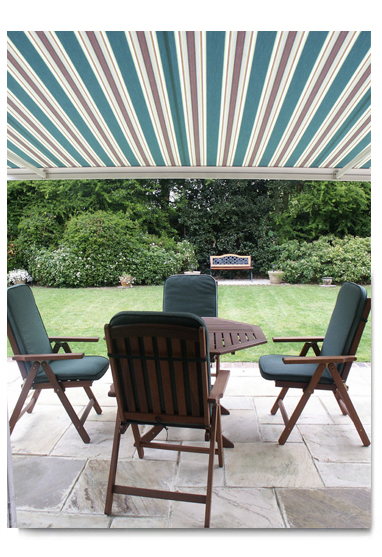
Turn your deck or patio into added living space, combining the comfort of indoors
with the enjoyment of outdoors by the addition of an awning. Here are some of
the benefits.
1. An awning shields out harmful sun rays while keeping you
cool. It blocks the sun from entering your home, cuts cooling
costs and protects furniture and carpet from fading.
2. Awnings are fully customizable and available in a wide
variety of style options and vibrant acrylic fabrics to
compliment any home.
3. An optional wind or motion sensor automatically retracts the
awning when wind speeds reach a predetermined level.
4. A sun sensor can be added to allow for automatic operation
determined by the sun’s strength.
5. An Interior wireless remote control can be added for
easy-access operation. When not in use, awnings can easily be
retracted, safely stored, and will subtly blend in with the
exterior beauty of any home.
Called an evaporative cooler, or “swamp cooler” this cooling system uses
seventy-five percent less electrical energy than a refrigerated central
air-conditioning system. Evaporative coolers have a catch: they only work in
very dry climates.
How Does it Work?
Evaporative cooling takes advantage of a simple physical principle: the process
of water evaporating (changing from a liquid into a vapor), which uses a great
deal of heat energy. So how does this process cool your house? This diagram
shows a simple evaporative cooler:
* Water is sprayed on a mesh of plastic or melamine, or trickles through pads
made of excelsior (wood wool, aspen fibers). * A blower draws hot, dry air
from outside the house through the mesh or pads and blows the now-cooled air
into the house. * Water sucks heat out of this incoming air stream. * The
air emerging from the evaporative cooler is 20 to 30 degrees cooler than what
went into it.
So Why Only Dry Climates?
The water involved in the vaporization process also goes into house as moisture.
In a hot, dry climate, this moisture is probably a welcome addition. But in a
humid climate, additional moisture is uncomfortable and can cause all kinds of
problems such as mold, rust and rot. The hotter and dryer the climate, the more
evaporation will occur, and the more effective the cooling system. For example,
at the time this article was written, the forecast for Phoenix, AZ called for a
high of 100o F and a relative humidity of 5%. In these conditions, the air
generated from the evaporative cooler will be about 70F.
Air Balance
Since the evaporative cooling system draws air into the home from outside, excess
air in the home must be expelled through open windows. The amount of cooling for
any room of the house is controlled by adjusting the window opening. Opening a
window wider allows more air out of the room and more fresh cool air to flow
into the room.
Maintenance
Evaporative coolers need more frequent maintenance than conventional central air
conditioning systems: a major cleaning and maintenance every season as well as
routine inspection and cleaning throughout the season. A technician usually
performs the seasonal maintenance. But you can do routine maintenance yourself.
The homeowner maintenance protocols depend on the type of system you have, but
in general the following should be done several times during the cooling season,
or as often as once per month in very hot climates:
* Shut off the power to the cooler. * Drain and flush the water and remove
scale and sediment from the water reservoir. * Inspect and replace, or clean,
pads and filters. * Inspect and clean the water distribution system.
If you live in a hot and humid climate, this system is not for you. But if you
live in a hot dry climate, you can take advantage of this economical and
effective form of cooling.
Your identity is often defined as a cocktail of characteristics - humor,
intelligence, warmth - and that can’t be seen with the naked eye. Various
research has revealed that a few physical traits can provide a telling glimpse
of who you are beneath the surface. If you:
Have dark eyes: You think quickly.
Tend to be ticklish: You’re sociable.
Are left-handed: You’re an artistic genius.
Have light eyes: You’re introspective.
Have allergies: You’re resilient.
Furniture can be so easily damaged. Here are a few “easy” ways to fix some minor
mishaps.
• Cover it up. Fill in scuffed areas with a matching wax crayon
or furniture marker.
• Iron it away. To even out a dent, cover it with a damp
washcloth, and iron the washcloth on medium heat. Caution: The moisture helps
lift the dent out of real wood, but can damage veneers.
• Ice it off. Don’t wipe off wax if it’s dripped onto a surface.
Instead, let it dry, then place an ice cube in a bag on top until it hardens,
and then scrape off with a credit card.
• Erase it with mayo. If a cold drink or vase left its mark on
your table, coat the area with mayo, leave for an hour, and wipe away the mark.
There are many
benefits to an evaporative cooler:
• They are inexpensive to install and
operate. • They work better as the day heats
up, performing at peak operation during the hottest part of the
day. • They provide a steady stream of fresh
air from outside, and a constant cool breeze throughout the
home. • Humidification makes the home more
comfortable and helps keep woodwork from drying out.
And now the cons
• They do not work well on humid
days. • Allergy sufferers may have a problem
from the constant stream of air and pollen from outside.
Household allergens can cause a variety of symptoms in many people, including sneezing, watery eyes, coughing, and shortness of breath. Allergens may also be a contributing cause of asthma, especially in children. However, it is possible to minimize the effects of such allergens by taking steps to control their presence and dispersal in the home.
The most common household allergens include dust mites, mold, mildew, pollen, and pet dander (dried flakes of skin shed by pets, particularly cats and dogs). Effective control relies on a combination of measures that, when used properly, will reduce the levels of allergens.
Increase ventilation to the home. Opening windows whenever possible promotes good air exchange and will reduce the concentration of airborne allergens, especially pet dander.
Wash bedding and stuffed toys once a week in hot water to control dust mites and cat allergens in particular.
Keep pets clean and well groomed to control dander.
Use mite-resistant mattress covers and pillow covers and wash these frequently.
Dust and vacuum regularly, and use microfiltration or HEPA filter vacuum bags. The jury is still out on whether bagless vacuum cleaners are more effective in removing allergens than those that require bags; some studies indicate that many bagless vacuums are not sealed tightly enough and can actually exacerbate the problem. Wearing a dust mask while dusting and vacuuming is also a good idea.
Consider removing wall-to-wall carpeting and use easily-cleaned area rugs instead, particularly in bedrooms.
Make sure bathrooms, especially those with showers, are well ventilated. Open the window and use exhaust fans that vent to the outdoors to prevent a buildup of moisture, which can encourage growth of mold and mildew.
If possible, reduce indoor humidity to 50% or less by using room dehumidifiers or the dehumidifier feature available with many central air conditioning systems.
Clean or replace furnace and central air conditioner filters on a regular basis. Make sure that air conditioner drain pans are clean and allow the water to drain properly.
For more information on allergens in the home, please contact your local Pillar To Post office.
There are no inspections available with this FBO within +/- 4 days of your preferred inspection date. Please pick another inspection date, or contact us.


 icon and select "Add to Home Screen".